
Understanding the PIS Score (Public Interest Score)

In South Africa, the Public Interest Score (PIS) is a simple but important measure used to decide what level of financial reporting and assurance a company is required to have. In short, the higher your PIS score, the more formal and independent your financial reporting must be.
What is the PIS Score?
The PIS score reflects how much public interest there is in your company. Companies that affect more people (employees, funders, customers, shareholders) are subject to higher reporting standards.
The score is calculated annually and determines whether your annual financial statements (AFS) need:
* No external work
* A Compilation
* An Independent Review
* A full Audit
How is the PIS Score Calculated?
Your PIS score is made up of the following:
1. Employees
* 1 point for each average employee during the year
2. Turnover
* 1 point for every R1 million (or part thereof) in annual turnover
3. Third-party liabilities
* 1 point for every R1 million (or part thereof) owed to third parties at year-end
4. Shareholders
* 1 point for each individual who has a beneficial interest in the company’s shares
Add these together and you get your PIS score.
Owner-Managed vs Non-Owner-Managed Companies
This distinction is critical.
Owner-Managed Company
A company is owner-managed only if ALL shareholders are also directors of the company.
If even one shareholder is not a director, the company is not owner-managed.
Non-Owner-Managed Company
A company where:
* There are shareholders who are not directors, or
* There are external investors who do not participate in management
Non-owner-managed companies usually require higher levels of independent oversight.
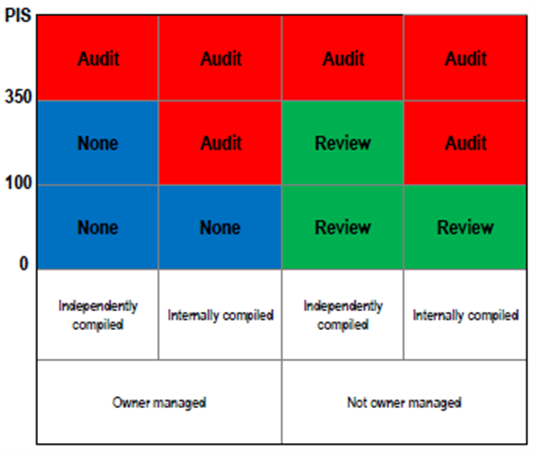
What Does Your PIS Score Mean in Practice?
Using the table above as reference, the requirements can be summarised as follows:
Summary
* For PIS below 100 and the company is owner-managed does not require an audit or an independent review. If not owner-managed then an independent review is required.
* PIS between 100 and 350 where the company's AFS are internally compiled requires an audit.
* For PIS between 100 and 350 where the company's AFS are independently compiled, and the company is owner-managed, no review or audit is required. If not owner-managed then an independent review is required.
* PIS score above 350 requires an audit in all circumstances.
Typical SME example
Companies with a PI Score of less than 100 which are owner-managed only require Compilation AFS.
These are usually small companies, with a couple of directors who are involved in the running of the business and they own all the shares in the company.
PIS Score do not apply to:
* Public companies (listed or unlisted),
* State owned entities,
* companies with fiduciary assets (i.e you hold assets/funds/cash on behalf of other e.g Attorneys and Rental Agents) exceeding R5 million and
* companies with a Memorandum of incorporation (MOI) that requires them to be audited.
All of these companies are subject to an audit by registered independent auditors anyway.
For the rest of the private companies, your level of assurance and financial standard to be used depends on whether the company is owner managed or not and whether the AFS have been internally compiled or independently compiled (by an external accountant).
Why This Matters?
Getting your PIS score wrong can lead to:
* Non-compliance with the Companies Act
* Rejected financial statements
* Unnecessary audit costs
* Issues with banks, investors, or regulators
At Thornberry, we help clients:
* Correctly calculate their PIS score
* Determine whether they are owner-managed
* Apply the correct level of reporting and assurance—no more, no less
Need Help?
If you’re unsure about your PIS score or what your company is required to do, we can assess it quickly and clearly—without overcomplicating things.
📩 hello@thornberry.co.za
🌍 thornberry.co.za
Read Other Blogs
What the Information Regulator Expects From Your Business
POPIA and PAIA compliance can feeloverwhelming for SMEs — but the basics are often simpler than expected. Learnwhat the Information Regulator requires, how Information Officer registrationworks, and whether your business needs a customised PAIA Manual.
“But My Company Pays My Taxes…” — Not Quite.
Your employer deducts tax—but doesn’t know everything. Missing info could mean refunds lost or costly SARS penalties.
The R2.3m VAT Threshold: Opportunity for Small Businesses — With a Catch
South Africa raises the VAT registration threshold to R2.3 million from April 2026, but businesses considering deregistration should first understand the potential exit tax consequences.
Which Xero Plan Is Right for Your Business?
A simple, no-jargon guide for South African business owners in choosing the correct Xero plan
What Is a SARS Registered Representative (RR)?
Who Really Answers to SARS? Behind every company’s tax number is a real person SARS holds accountable. A SARS Registered Representative (RR) isn’t just a tick-box appointment — it’s the individual legally responsible for ensuring a business’s tax affairs are accurate, compliant, and up to date. Whether you’re a director, trustee, or founder, understanding the RR role is critical to protecting your business, avoiding penalties, and working effectively with your tax practitioner.
VAT: When to Register, What Happens If You Don’t, and How VAT Actually Hits Your Prices
VAT for South African businesses doesn’t hinge on profit—it hinges on your rolling 12-month taxable turnover. This quick guide explains when you must register, the risks of ignoring it, and how VAT actually affects your pricing with vendors and non-vendors.
The Essential Elevator Pitch Deck: Crafting a Concise and Compelling Presentation
Crafting the perfect elevator pitch is as much about what you put into it as what you shouldn't.


